In what order should kids learn the times tables?
Short answer
Start with the 2s, 10s and 5s, then the 4s, 3s and 8s, and leave the 6s, 7s and 9s for last. That is the order of the national curriculum in England, and it works because each new row builds on the easy ones: the 4s are double the 2s, and 9 times a number is 10 times it minus the number. Here is when schools teach which row, how kids can work out facts instead of memorizing all of them, and how to practice at home.
On this page
When schools teach which row
| Where | When | Which times tables |
|---|---|---|
| England | Year 2 (age 6 to 7) | 2, 5 and 10 |
| Year 3 (age 7 to 8) | 3, 4 and 8 | |
| Year 4 (age 8 to 9) | all up to 12 × 12, with the Multiplication Tables Check in June | |
| US | 3rd grade | all products of two one-digit numbers, known from memory by the end of the year |
| Germany | 2nd grade | all up to 10 × 10, known from memory by the middle of 3rd grade |
Multiplication and division go together: 7 × 8 = 56 also gives 56 ÷ 8 = 7. England and the US teach the two side by side.
Start with the easy rows
- The 10s: add a zero.
- The 2s: double the number.
- The 5s: half of the 10s. They always end in 0 or 5.
- Square facts like 3 × 3 or 6 × 6 are easy to remember too.
German math teachers call the facts with 1, 2, 5 and 10 in each row the core facts (“Kernaufgaben”). Once a kid knows 2 × 7, 5 × 7 and 10 × 7, the rest of the 7s can be worked out from them.
Work facts out instead of memorizing all of them
- Swap. 3 × 8 is the same as 8 × 3. That turns the 100 facts up to 10 × 10 into 55 different ones.
- Double. The 4s are double the 2s, the 8s double the 4s, the 6s double the 3s: 4 × 7 is 2 × 7 doubled.
- Go to the neighbor. 6 × 7 is 5 × 7 plus one more 7: 35 + 7 = 42. And 9 × 6 is 10 × 6 minus one 6: 60 − 6 = 54.
Kids who work facts out this way don’t get stuck when they forget one. After a while they simply remember them.
Practicing at home
- One row at a time first: the row in order, then the same row mixed up, then rows mixed with each other.
- Division alongside: when 7 × 8 sits, ask 56 ÷ 8 too.
- Short and often: a few minutes on most days work better than one long session.
- Speed last: the check in England gives 6 seconds per question, but speed comes once the facts sit. A timer before that mostly adds pressure.
Free worksheets, each with an answer page: the 2s, 3s, 4s, 5s, 6s, 7s, 8s, 9s, 10s and all mixed up.
How Solve To Play fits in
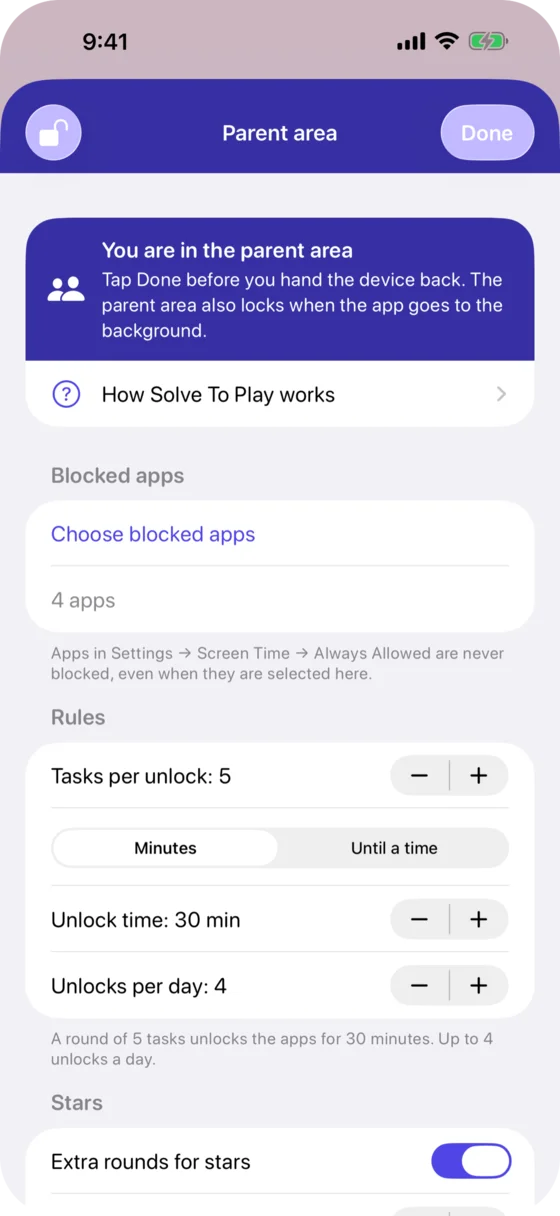
- Three task types: Multiplication (7 × 8), Missing number (7 × ? = 56) and Division (56 ÷ 7). You switch each one on or off.
- A range of numbers: you set the range, for example 2 to 5, and both numbers of every task stay inside it. Widen it as your kid learns more rows. Because the app mixes rows, it suits the rows your kid already knows; for a new row, start with the worksheet.
- By grade: the grade preset switches the times tables on in 3rd grade with 2 to 10 (2nd grade in Germany), and 4th grade and up uses 2 to 12.
- Missed facts come back. A fact your kid got wrong turns up again in later rounds, and 3 × 7 and 7 × 3 count as the same task.
- No timer. Your kid can take the time a fact needs.
Questions parents ask
How long does it take to learn the times tables?
Schools spread them over one to three years. In England they run from Year 2 to Year 4, in the US they should sit by the end of 3rd grade, and in Germany kids start in 2nd grade and should know them all by the middle of 3rd grade.
What is the Multiplication Tables Check?
A check for Year 4 pupils in England, held in June. It asks 25 questions from the 2 to 12 times tables, with 6 seconds for each, and there is no pass mark.
Can Solve To Play practice only the 7s?
No. The app picks both numbers of a task from a range, such as 2 to 7, so it mixes rows. For one row on its own, print the worksheet for the 7s.
Sources
- Department for Education: National curriculum in England: mathematics programmes of study.
- Common Core State Standards: Grade 3, Operations and Algebraic Thinking, standard 3.OA.C.7.
- PIK AS, TU Dortmund: Das kleine 1 · 1 richtig üben (letter to parents, German, PDF).
More guides
Screen time rules for kids 6 to 10
What US, UK, Canadian and Australian guidelines say about screen time for kids 6 to 10, which rules cut the daily fight, and how to let the iPad hold the rule.
Is screen time as a reward a bad idea?
What research says about screen time as a reward, and how to set up math before games so the daily limit stays and math doesn't turn into a chore.

An app that makes kids earn screen time with math
How your kid solves a few math tasks before games and YouTube open on an iPhone or iPad: what Apple's Screen Time can do, and what Solve To Play adds.