Is screen time as a reward a bad idea?
Short answer
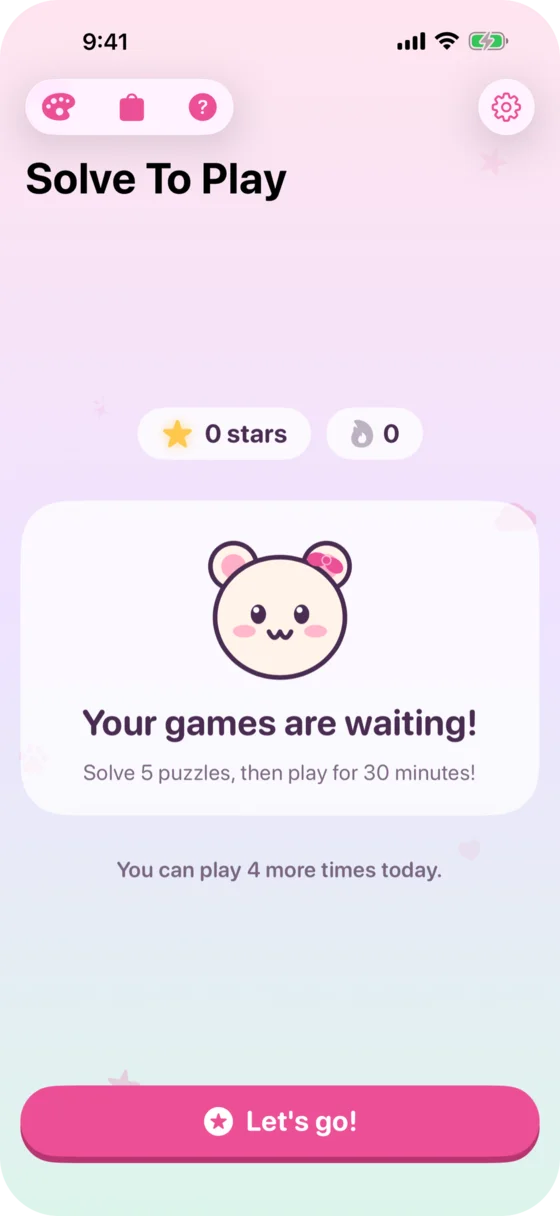
It can be, when the reward means more screen time. In a small study, kids whose parents gave or took away screen time for behavior spent more time on screens. Math before games works differently when the daily limit stays where you set it and the tasks only decide when the playtime starts. Here is what research says and how to set it up.
On this page
The worry
Two worries come up when parents talk about this:
- Screen time becomes more precious when it is a prize, and kids end up with more of it.
- Rewards take the fun out of things. A kid who has to do math to get to the games learns that math is something you only do for a prize.
Both have research behind them, and both depend on how the reward is set up.
What research says
More screen time. A study from the University of Guelph in Canada, published in BMC Obesity, found that young children whose parents used screen time as a reward or took it away as a punishment spent more time on screens. The study was small (62 children aged 18 months to 5 years) and shows a link, not a cause. Its lead researcher compared it to dessert as a reward, which makes kids want dessert more.
Less fun. A review of 128 experiments by Deci, Koestner and Ryan (1999) found that expected rewards like toys or money lower interest in tasks people already enjoy, and more so in children than in college students. For tasks people found dull, rewards had no such effect. The same review found that praise and positive feedback raised interest.
So the useful question is less “reward or not” and more “what does the reward change?”.
Math before games, with the limit kept

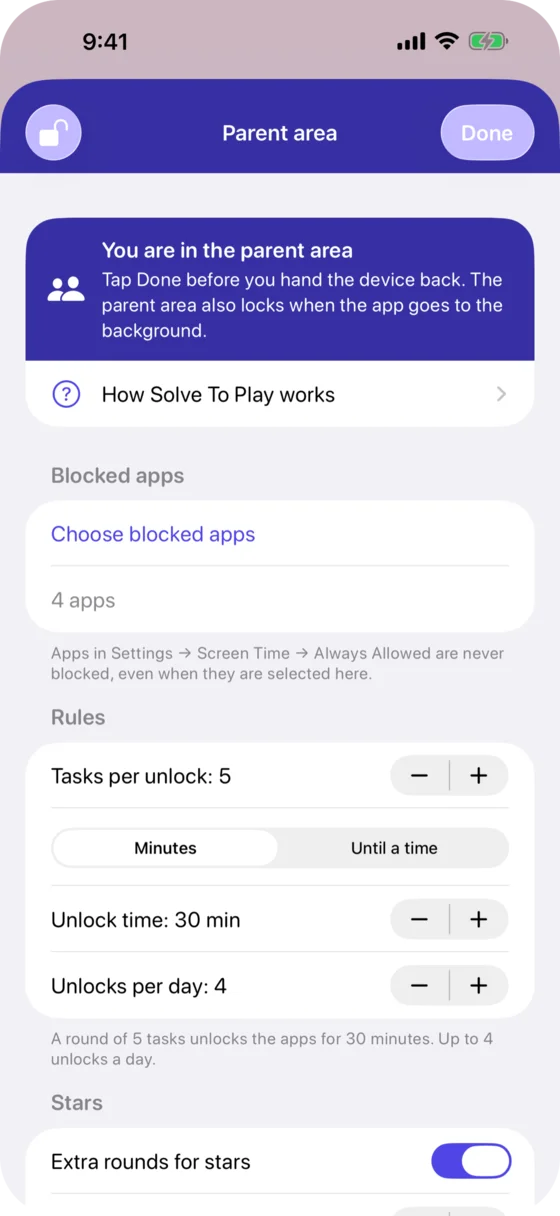
- The limit stays where you set it. Each round opens the apps for the time you chose (5 minutes to 3 hours), and the unlocks per day (1 to 12) cap how often that works. More math only means more screen time if you allow unlimited unlocks a day.
- Stars never buy playtime. Each solved task earns a star, and stars buy things for your kid’s character in the shop. The reward that grows is not more screen time.
- Extra rounds for stars. When the apps are already open or the day’s unlocks are used up, your kid can keep solving for stars only. Some of the first kids who tried the app kept solving after their apps were open, and that is why extra rounds exist. You can switch them off or cap them per day.
- Help instead of pressure. There is no timer. A wrong answer can be tried again, a dot picture helps with small numbers, and after the third wrong try the app shows the answer. Missed tasks come back in later rounds.
Keeping math from turning into a chore
- Start easy. The school grade you pick at setup sets numbers your kid has learned. If rounds end in tears, lower the numbers before anything else.
- Keep rounds short. Three to five tasks are enough for a daily routine. You can add more later.
- Don’t use tasks as a punishment. Extra tasks for bad behavior turn math into the punishment.
- Praise the effort. In the review above, praise raised kids’ interest. Say something about the work, not only about the unlock.
- Agree on the rule once. When the rule is the same every day and the app holds it, there is less to argue about.
Questions parents ask
Does solving more tasks give my kid more screen time?
Only if you allow it. Each round opens the apps for the time you set, and the unlocks per day cap how many rounds count. With no limit on unlocks per day, every round opens the apps again, so keep a daily limit if you want a fixed total.
Can my kid buy playtime with stars?
No. Stars buy hats, glasses and other things for your kid’s character in the shop. They never buy playtime, and stars can’t be bought with money.
What if my kid only does the math to get to the games?
For practice like times tables, that is fine. In the research below, rewards didn’t lower kids’ interest in tasks they found dull to begin with. Keep the rounds short and the numbers easy enough that most answers are right.
Sources
- University of Guelph: Controlling children’s behaviour with screen time leads to more screen time (2019), on Tang, Haines et al., BMC Obesity.
- Deci, E. L., Koestner, R. and Ryan, R. M. (1999): A meta-analytic review of experiments examining the effects of extrinsic rewards on intrinsic motivation. Psychological Bulletin 125(6), 627–668.
More guides
Screen time rules for kids 6 to 10
What US, UK, Canadian and Australian guidelines say about screen time for kids 6 to 10, which rules cut the daily fight, and how to let the iPad hold the rule.
In what order should kids learn the times tables?
The order schools in England, the US and Germany teach the times tables, the easy rows to start with, the tricks that save memorizing, and how to practice.
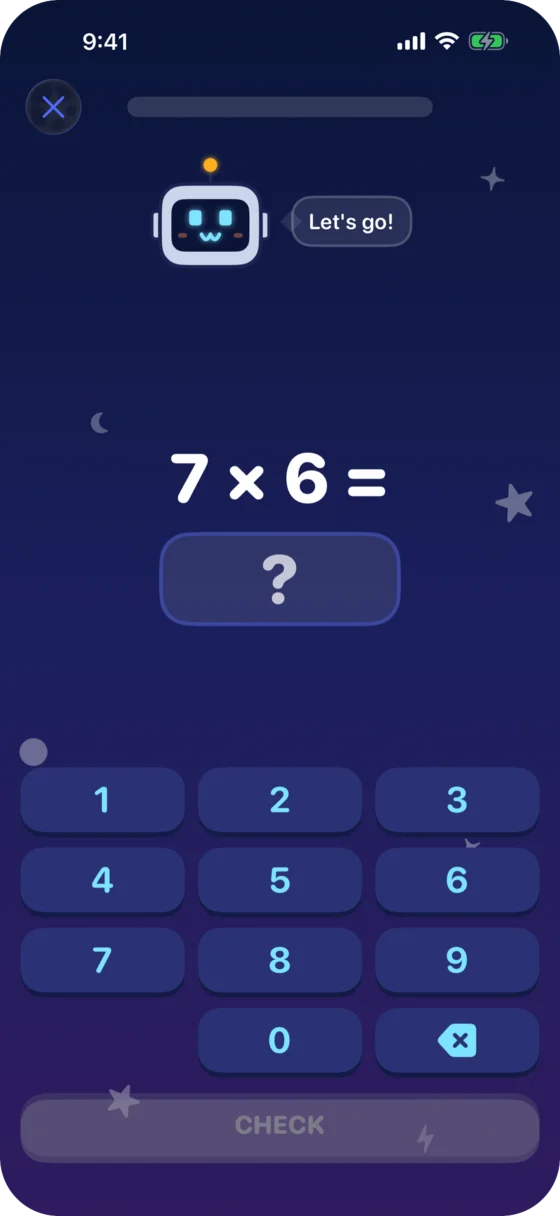
An app that makes kids earn screen time with math
How your kid solves a few math tasks before games and YouTube open on an iPhone or iPad: what Apple's Screen Time can do, and what Solve To Play adds.